
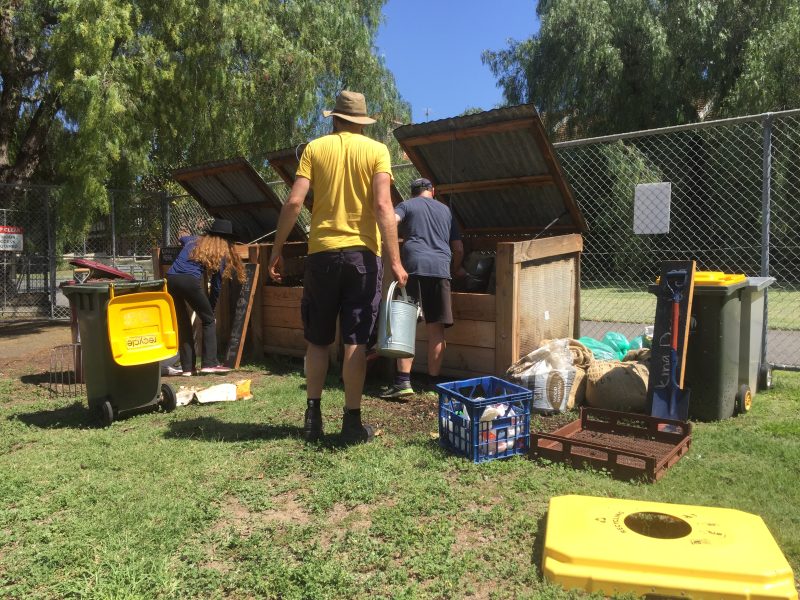
In Kensington, Victoria, local residents are driving a bold and innovative vision to manage food waste sustainably. This initiative not only brings neighbours together but also helps build a thriving and healthy food gardening community. Supported by the City of Melbourne, the project actively reduces waste sent to landfills and promotes ways to live within ecological boundaries without compromising our quality of life.
The project began with a simple yet profound observation: a significant amount of food waste generated by households in this inner-city suburb could be conserved and processed on-site in the many green spaces and council gardens, and returned directly to the local food system. Recognising the massive potential for composting, a dedicated committee formed to support locals to add food scraps and compost them in multiple locations around the neighbourhood. The Sharewaste app and regular social media updates directed new composters to the nearest composting sites.
The response was overwhelmingly positive. In 2018, the project was nominated for a Premier’s Sustainability Award. At one point, a network of at least fourteen compost bin and worm farm locations was operating within a single square kilometre, supporting a growing base of composters in Kensington and surrounding suburbs, ensuring everyone had convenient access to composting facilities nearby.
Melbourne city council stepped in to support these community-led efforts, offering a site behind Kensington Town Hall to serve as a central composting depot. This hub, opened in 2019, supports other sites while providing a space for developing skills and techniques related to composting. Over the years, a team of various funded and volunteer contributors have developed an increasingly structured and efficient system. The focus has been on making it easy for everyone to get involved in composting while ensuring the process is clean, productive, and not disruptive to surrounding residents. Within a year or two, the value of the space became clear, and the management committee set a simple vision: to capture and conserve all organic waste locally in Kensington, converting it into the resources required to further develop a sustainable food system.
In 2024, the council and Sustainability Victoria provided funding for a custom-designed ecargo bike to transport food scraps and finished compost around the neighbourhood. This presents new opportunities to efficiently collect waste without producing fossil fuel emissions, scaling up what is possible, aligning with the council’s sustainability goals, and supporting the aims of the compost hub.
Dave Goodman, the compost cargo bike operator and roving compost technician, is now a familiar sight around town, collecting food scraps from cafes and greengrocers, and moving compost and carbon sources where they are needed, usually using a variety of containers lashed to the bike’s rear carrier.
“The ecargo bike has really been a game-changer,” Dave says. “It enables us to cover more ground, all while reducing our carbon footprint as close to nothing as possible. Having a widespread network of composting sites not only makes it more realistic for people to keep composting on an ongoing basis, but it means we can share resources and divert the materials to where they are most useful. Even in a small suburb like Kensington, we could do this on foot using handcarts and trolleys, but while we still only have a dozen or so locations, the distances involved make it too time-consuming to scale well. The ecargo bike really bridges that gap until we get a compost station on every block or on every street.”
The collected food scraps are composted at several distributed locations throughout the area. The resulting nutrient-rich fertiliser is then distributed to various community gardens across Kensington. Understanding the resource and logistics inputs required to make this system work is based on practical experience and documentation.
The initiative has not only reduced food waste but has also fostered a strong sense of community among residents. Local schools and childcare centres have also gotten involved, using the project as an educational tool to teach students about composting and sustainable waste management.
“The response from the community has been fantastic,” Dave said. “People are not just participating; they are actively engaged and passionate about making a difference. Letting organic resources go to waste is huge problem, and we aren’t going to solve it by throwing more fossil fuels at the problem. So it is also a massive opportunity to think about how we interact with supply chains at a human level, using natural processes and freely available energy sources. The future is local, and it must involve all of us getting to participate in any way we can.”
Residents, councillors and visiting academics have all praised the effort, highlighting this initiative as a model for sustainable waste management. This ongoing work is a testament to what a community can achieve with the right support and a community that is prepared to support and invest in each other’s future.
Leave a Reply